
PTSD Service Dogs: Training, Costs, and Your Legal Rights
Last updated: September 2026
A lot of veterans with PTSD ask me about service dogs. Usually they've seen a friend's dog, or read something online, and they want to know two things: will it help, and how do I get one?
Those are good questions, and there's a lot of bad information out there. Some websites will sell you a "certification" and a vest for $100. Some people assume VA will hand you a dog. Neither is true. This post covers what a PTSD service dog actually does, what the research says, what the law requires (and doesn't), what it costs, and where VA fits in.
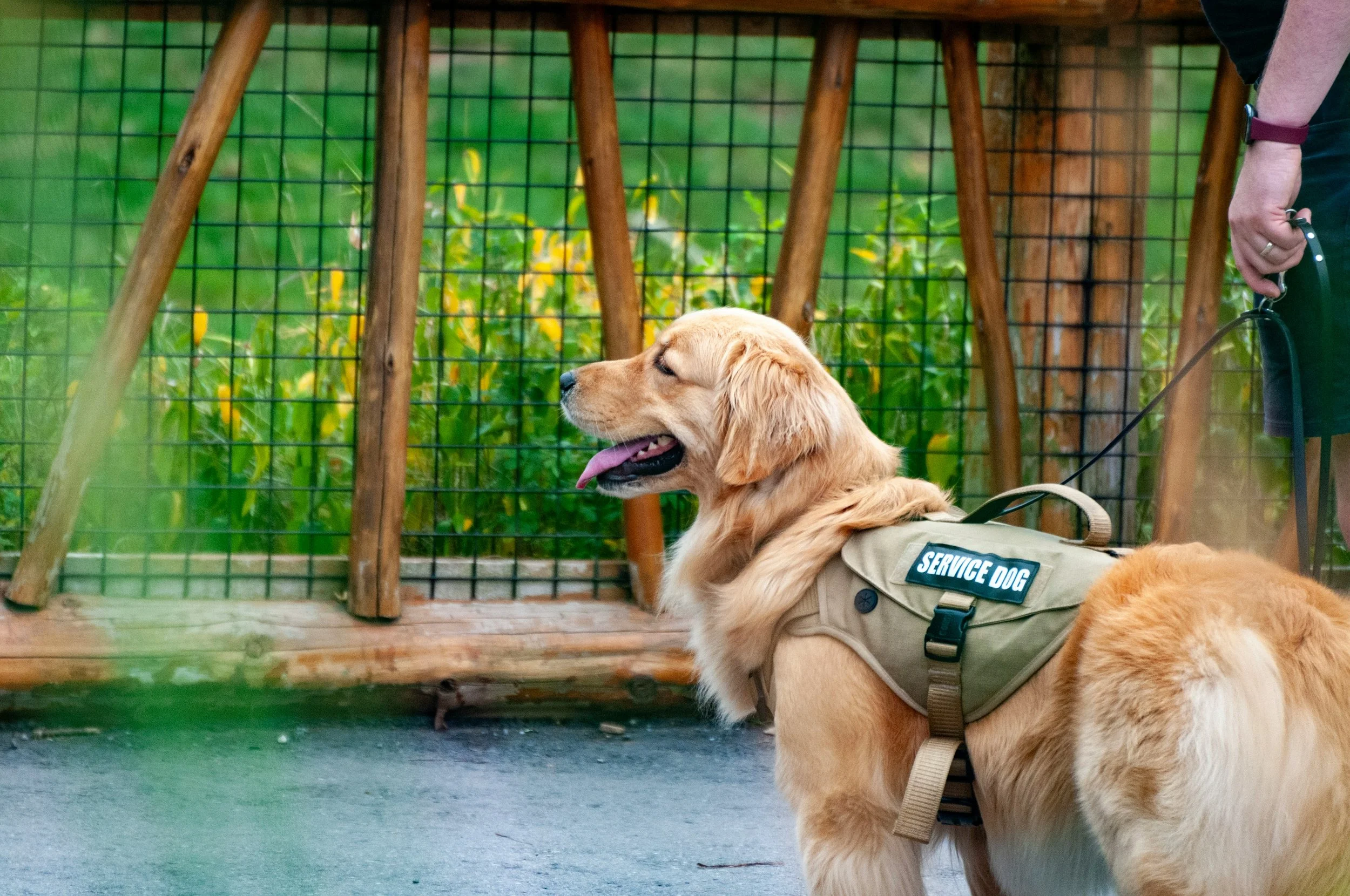
What a PTSD Service Dog Does
A service dog isn't a pet with a vest. Under the Americans with Disabilities Act (ADA), a service dog is a dog that has been individually trained to do work or perform tasks for a person with a disability. For PTSD, those tasks are specific, trained behaviors that help with symptoms. Common examples include:
Waking you from a nightmare by nudging you or turning on a light
Noticing signs of rising anxiety and interrupting them before a panic attack builds
Applying deep pressure by leaning or lying across you to help calm your body
Standing in front of or behind you in a crowd to create personal space
Checking a room before you enter so you feel safer
Reminding you to take medication at a set time
The ADA's own guidance uses PTSD as an example. The Department of Justice's service animal page describes a dog trained to lick a person's hand to alert them to an oncoming panic attack. What matters is the training. A dog whose only job is to provide comfort just by being there doesn't count as a service dog under the ADA, even if that comfort is real and helpful.
Service Dogs vs. Emotional Support Animals vs. Therapy Dogs
These three terms get mixed up constantly, and the difference affects where your dog can go with you.
| Type | What it does | Public access (stores, restaurants) | Housing | Flights |
|---|---|---|---|---|
| Service dog | Trained to perform tasks related to a disability | Yes, under the ADA | Yes, under the Fair Housing Act | Yes; airlines may require a DOT form |
| Emotional support animal | Provides comfort by being present; no task training needed | No | Often yes, as an "assistance animal" | No; airlines can treat them as pets |
| Therapy dog | Visits hospitals, schools, or nursing homes to comfort others | No | No special rights | No |
Housing and air travel follow different laws than the ADA. The Fair Housing Act uses a broader term, "assistance animal," which can include emotional support animals. For flights, the Department of Transportation changed its rules in late 2020. Airlines no longer have to treat emotional support animals as service animals. They must treat psychiatric service dogs the same as any other service dog. Airlines can ask you to fill out a DOT Service Animal Air Transportation Form about your dog's health, training, and behavior, sometimes up to 48 hours before your flight.
What the Research Says
For years, the evidence on PTSD service dogs was mostly stories. That's starting to change.
In 2024, researchers at the University of Arizona published the largest study of its kind in JAMA Network Open. According to the National Institutes of Health, which funded it, 81 post-9/11 veterans who received service dogs from K9s For Warriors were compared with 75 veterans still on the waitlist. After three months, the veterans with dogs reported less severe PTSD symptoms, less anxiety and depression, and less social isolation.
That's encouraging, but it has limits. The study only lasted three months, and everyone in it kept getting their regular care. The lead researcher said service dogs should be seen as a complement to treatment, not a replacement for it. I agree. A service dog can be a powerful part of your recovery plan, but it works best alongside therapy, not instead of it. If you're weighing treatment options, my post on VA vs. private mental health care can help.
The Truth About "Certification"
This is the part that surprises people most. Under the ADA, there is no official service dog certification, registry, or ID. According to the DOJ, service dogs aren't required to be certified, go through a professional training program, or wear a vest.
That means every website selling a "service dog certificate" or "registration" is selling you something with no legal meaning. Those products don't give you any rights you didn't already have. Worse, they make life harder for real service dog teams, because they encourage people to pass off untrained pets as service animals.
When it isn't obvious what a dog does, businesses covered by the ADA can ask only two questions: Is the dog a service animal required because of a disability? And what work or task has the dog been trained to perform? They can't ask about your diagnosis, demand paperwork, or ask the dog to demonstrate a task.
Your rights come with responsibilities. Your dog must be housebroken and under your control, usually on a leash or harness unless that gets in the way of its work. A business can ask you to remove a dog that's out of control or not housebroken.
If you live in Washington State, there are a couple of extra rules. It's a civil infraction, with a fine of up to $500, to knowingly misrepresent an animal as a service animal. Washington law also covers service animal trainers, who can bring a dog in training into places open to the public as long as the dog stays under control. The federal ADA doesn't protect dogs in training, so check your own state's rules if you live elsewhere.
Work is its own situation. Bringing a service dog to your job falls under a different part of the ADA, which deals with reasonable accommodations. Your employer can ask for more information than a store can. I cover that in more detail in PTSD in the Workplace.
Are You Ready for a Service Dog?
Before you apply anywhere, be honest with yourself about a few things.
Talk to your provider first. A service dog is a medical decision as much as a personal one. Your mental health provider can help you figure out whether a dog fits your treatment plan and which tasks would actually help your symptoms. Most reputable programs will want documentation of your diagnosis and a provider's support.
Think about your daily life. A service dog needs exercise, feeding, grooming, vet care, and bathroom breaks every single day, including on your worst days. Do you have the physical ability to handle a dog? Does your housing allow one? Is your household stable enough to give a dog consistent care?
Think about attention. A dog in public draws questions and comments. For some veterans with PTSD, that's a real stressor. Talk it through before you commit.
Plan for the long haul. Service dogs work for years, and you'll need to keep up their training the whole time. They'll eventually retire, and you'll need a plan for that too.
How PTSD Service Dogs Are Trained
Training usually happens in stages. It starts with socialization, where a young dog gets used to all kinds of people, places, sounds, and situations. Then comes obedience and public access training. That means staying calm around food and other dogs, ignoring distractions, and staying focused on the handler in busy places. After that, the dog learns specific tasks matched to its future handler's needs.
The last stage is team training, where you and the dog learn to work together. You'll learn how to give commands, keep up the dog's skills, handle public interactions, and understand your rights. Many programs do this over a few weeks, sometimes at their facility.
The full process often takes well over a year from puppy to working dog. Some programs speed things up by starting with adult rescue dogs. Either way, rushing it rarely ends well.
Program vs. Owner-Training
You have two main paths.
A professional program. An organization selects the dog, trains it, and then matches it with you. Many nonprofits do this at no cost to veterans, paid for by donations. The tradeoff is usually a long waitlist. Look for programs accredited by Assistance Dogs International (ADI). ADI accreditation matters for VA benefits, too, as you'll see below.
Owner-training. The ADA lets you train your own service dog. Some veterans do this with help from a professional trainer. It can work, but it's hard. Not every dog has the right temperament, and it takes serious time and skill. You also won't qualify for VA's veterinary benefit, which requires an accredited program.
Whichever route you choose, watch for red flags. Be cautious of anyone who promises a fully trained dog in a few weeks, skips a real application process, won't explain their training methods, or pushes online "certification." A good program will be upfront about its timeline, methods, and costs, and should be willing to connect you with past graduates.
What It Costs
Service dogs are expensive to train. Programs and veterans often cite figures in the tens of thousands of dollars per dog. One veteran featured on a VA Madison story found quotes of $25,000 to $45,000 before finding a nonprofit that trained his own dog for free.
The good news is that many nonprofits provide dogs to veterans at no cost. The catch is the wait, which can be long. Apply to more than one program if you can.
Even with a free dog, you'll have ongoing costs: food, vet care, gear, grooming, and refresher training. Build those into your budget before you bring a dog home.
How VA Can Help
VA doesn't buy service dogs for veterans. But it does have a few programs worth knowing about.
Veterinary health insurance. Under VA's service dog benefit, eligible veterans can get veterinary health insurance for their service dog and travel pay to an accredited training program. To qualify, your dog must come from an organization accredited by ADI or the International Guide Dog Federation. The benefit covers dogs for veterans with vision, hearing, or substantial mobility impairments.
Mental health mobility dogs. Veterans whose mental health condition is the main cause of a substantial mobility limitation may also qualify. Your VA mental health provider and care team decide whether your condition fits and whether a dog is the best treatment option for you. If they agree, they request the benefit through your local VA Prosthetic and Sensory Aids Service. "Mobility" here can include not being able to leave the house or get to appointments because of your symptoms, so don't rule yourself out without asking.
The PAWS pilot program. The PAWS for Veterans Therapy Act, signed in 2021, created a five-year VA pilot where veterans with PTSD help train service dogs as part of their treatment. Veterans in the pilot may be able to adopt the dog they helped train. It runs at a limited number of VA sites, so ask your VA mental health provider whether there's one near you.
Life With a Service Dog
Once you're a team, a service dog changes your routine. You'll plan around walks, meals, and bathroom breaks. You'll practice commands regularly so the dog's skills stay sharp. And you'll get questions from strangers. You don't have to answer them, and people aren't supposed to pet a working dog. Some handlers keep a short, polite answer ready. Others just say "She's working" and keep moving.
Travel takes extra planning. Check your airline's service animal policy, fill out the DOT form ahead of time, and leave yourself extra time at the airport.
Connecting with other handlers helps, too. Many training programs keep alumni groups, and other handlers are often the best source of practical advice.
A service dog is a medical tool and a living partner at the same time. For a lot of veterans, that bond, and the daily responsibility of caring for another living thing, becomes part of the healing.
Conclusion
The journey to obtaining a service dog for PTSD isn't easy, but it's absolutely worth it. If you think a service dog might help, start with a conversation with your mental health provider. Ask whether a dog fits your treatment plan, and if you use VA care, ask about the service dog benefit and the PAWS pilot. Then research ADI-accredited programs and get on a waitlist or two.
Looking for the right kind of support? Finding care that fits you can take some trial and error, and asking for help is a strong first step. Schedule a free consultation to talk through your options.
Know a veteran or family member who could use this? Share it.